The lead that ancient Mayans used to decorate buildings, pottery, and burial sites may have led to lake pollution and the destruction of two aquatic ecosystems. This conclusion was reached by researchers studying bottom sediments in the northern Yucatán Peninsula.
The work was published in the journal Science Advances.
According to them, toxic pollution could have been an additional factor exacerbating environmental problems during the flourishing period of Mayan civilization.
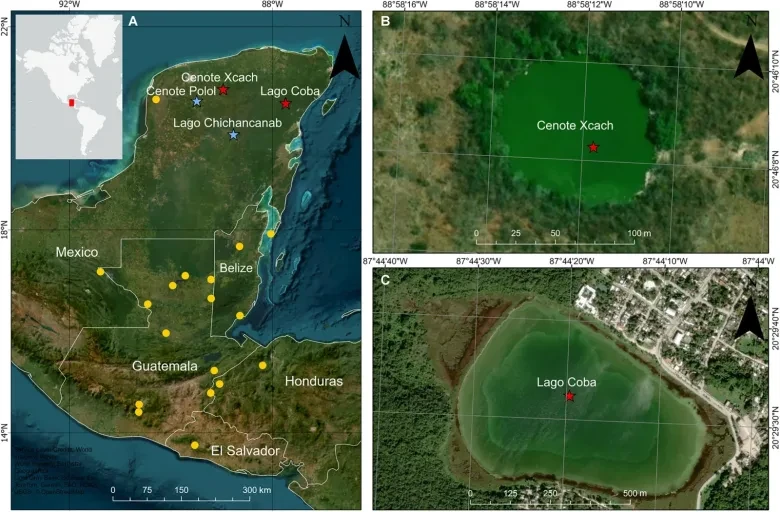
Scientists from Auburn University in the USA, led by Matthew Neil Waters, collected bottom sediment samples from Lake Coba and the Shk’ach Cenote, a natural water reservoir in a karst depression. Analysis of wood and charcoal showed that some sediment layers formed more than two thousand years ago. The researchers then measured the lead content in sediments from different periods and studied the remains of algae, bacteria, and small aquatic animals.
In Lake Coba, lead concentration began to rise around 40 AD and peaked between 250–300 AD. By 520 AD, levels had returned to natural values. In the Shk’ach Cenote, pollution was more intense and lasted longer; peak values were recorded around 720 AD.
Periods of high lead concentration coincided with significant changes in aquatic ecosystems. Traces of algae and bacteria declined considerably, while remains of small aquatic animals almost disappeared.
No high lead content was found in two other studied lakes. This suggests that the pollution was not caused by atmospheric lead dispersion. Most likely, the metal or the red mineral containing it, cinnabar, seeped into reservoirs from surrounding areas where the Mayans used it.
The researchers believe that pollution could also have affected nearby human populations. Prolonged lead exposure probably worsened the consequences of droughts and deforestation.