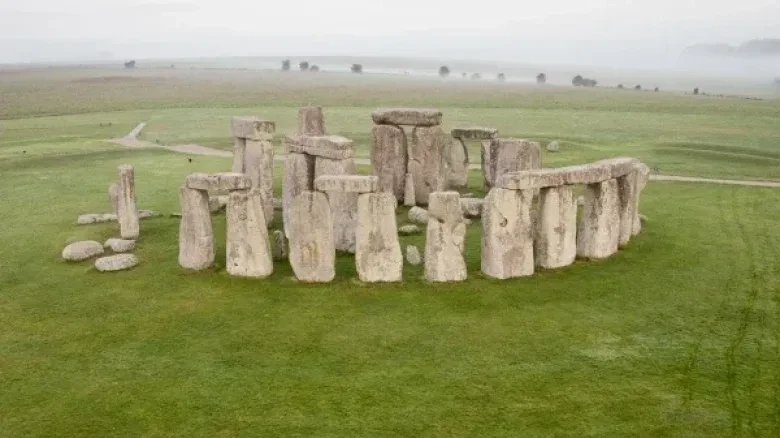
Geologists have so far been unable to determine the origin of the six-ton Stonehenge altar stone, but a new study has narrowed the search area. Analysis of samples has shown that the stone was most likely brought not from northeastern Scotland, as previously assumed by scientists, but from another region of Scotland, northern England, or possibly Ireland.
The study "Searching for the origin of the Stonehenge altar stone" was published in the Journal of the Geological Society.
In 2024, experts from Great Britain and Australia proposed that the sandstone composing the altar stone originated from northeastern Scotland. This discovery sparked interest in the question of how Neolithic people managed to transport a multi-ton stone block over a distance of more than 640 kilometers—whether by land or by sea.
To test this hypothesis, an international team of researchers studied the stone’s composition, including eight fragments held in museums. Scientists then traveled to northeastern Scotland and collected about 70 rock samples for laboratory analysis.
The results showed that the rocks found did not match the characteristics of the altar stone. Duncan Pirie, honorary professor at the University of South Wales and lead researcher, stated that the stone’s origin remains a mystery. At the same time, he emphasized that this study is the most extensive geological investigation conducted on the altar stone to date.
The scientists noted that excluding potential source locations is no less important than finding matching rocks; it gradually narrows the search area.
Determining the precise location from which the stone was brought is important not only for geology. It will also help better understand how the people who built Stonehenge lived, what territories they occupied, and how far their connections extended.