





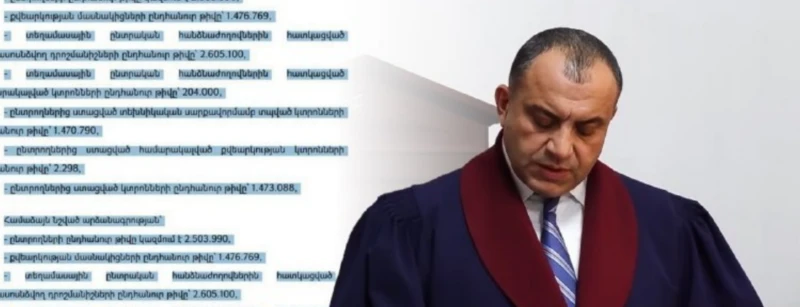
"Zhoghovurd" daily writes: "Zhoghovurd" daily found out that there are a number of significant numerical inconsistencies with the arithmetical combination of the electoral summary data published in the official decision of the Constitutional Court of the Republic of Armenia on July 4.
After studying the applications, the explanations of the representatives of the applying and responding parties, the representatives of the related respondents, the third party, the other documents and materials in the case, the Constitutional Court P A R Z E T S, after the sentence, the CC presented figures according to which the counting of receipts for thousands of voters does not match.
"Zhoghovurd" daily found out that, in addition, there is a difference between the allocated and counted numbered coupons, and the number of self-adhesive stamps used exceeds the number of voting participants. Moreover, the total difference obtained from these calculations does not coincide with the "total amount of inaccuracies" mentioned in the decision of the Constitutional Court. Thus, according to the data recorded by the decision of the RA Constitutional Court, the total number of voters was 2,503,990, and 1,476,769 voters participated in the voting.
According to the same decision, the total number of coupons printed with technical equipment received from voters was 1,470,790, and numbered voting coupons - 2,298. The sum of these two indicators is 1,473,088, which corresponds to the "total number of receipts received from voters" indicator separately mentioned in the decision.
But here, according to the calculation of "Zhoghovurd" daily, the first inconsistency arises. If 1,476,769 voters participated in the voting, and the total number of coupons received is 1,473,088, then the difference is 3,681. In other words, according to the data published in the decision, a corresponding receipt was not recorded for 3,681 participants.
In that case, how was the voting organized? The second inconsistency, according to the calculation of the "Zhoghovurd" daily, concerns the numbered voting slips. According to the decision, 204,000 numbered coupons were allocated to precinct election commissions. At the same time, it is noted that 2,298 numbered coupons were received from voters, and 202,121 numbered coupons remained unused. The sum of these two numbers is 204,419, while the total number of coupons issued was 204,000.
It turns out that there is a discrepancy of 419 coupons in the balance, that is, the total number of counted used and unused coupons exceeds the allocated amount by 419. The third discrepancy, according to "Zhoghovurd" daily, concerns self-adhesive stamps. According to the decision of the Constitutional Court, 2,605,100 self-adhesive stamps were allocated to precinct election commissions, of which 1,127,734 remained unused. From this data, it follows that 1,477,366 stamps were used. However, according to the same decision, it is recorded that 1,476,769 voters participated in the voting. In other words, the number of used stamps is 597 more than the number of voting participants. Where they were used, how and by whom is not clear. Thus, the arithmetical combination of the numbers published in the decision of the RA Supreme Constitutional Court shows at least three numerical discrepancies: 3,681 between the voting participants and the counted coupons, 419 between the allocated and counted numbered coupons, and 597 between the used stamps and the voting participants.
The sum of these differences is 4,697.
Meanwhile, in the same decision, the number 4,331 is mentioned as the "total amount of inaccuracies". That is, even the difference obtained as a result of a simple arithmetical combination of the numbers presented in the official document exceeds the "total amount of inaccuracies" recorded in the decision by 366.
The fact that during the sessions of the Constitutional Court, the judges of the court repeatedly tried to get a logical and mathematically justified explanation of the presented numbers from the Chairman of the RA Central Electoral Commission, Vahagn Hovakimyan, was public. the sessions were open and those questions were available to everyone. However, the court's mission was not limited to asking questions. The Constitutional Court should have assessed the presented evidence and numerical data, highlighted the possible contradictions in them and given a clear answer in its decision as to what caused the numerical inconsistencies in the official records. However, the published decision does not contain such an assessment.
Meanwhile, that very decision became the legal act that concluded the dispute regarding the constitutionality of the 2026 elections. The President of the Constitutional Court, Arman Dilanyan (Chairman), Edgar Shatiryan (Rapporteur), Davit Khachaturyan, Yervand Khundkaryan, Hovakim Hovakimyan, Seda Safaryan and Artur Vagharshyan participated in the decision-making.