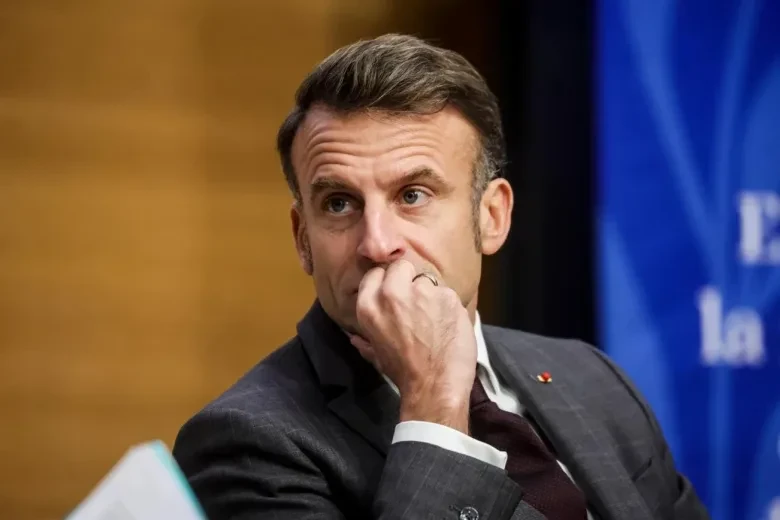
French President Emmanuel Macron has a secret bunker in the suburbs of Paris where he can be relocated in the event of mass unrest and an assault on the Élysée Palace. This is stated in the investigative book La Nouvelle Armée des Ombres ("The New Army of Shadows") authored by journalists Pierre Gastineau, Antoine Izambard, and Frank Reynaud.
According to the authors, plans for the president’s evacuation began to be developed particularly in 2018 after the "yellow vest" protests. At that time, Macron had confronted angry protesters during a visit to the town of Le Puy-en-Velay. "The government trembled," one of the authors recalls in an interview with France Inter radio.
As The Telegraph writes, referring to the book, French special services are preparing for possible unrest, sabotage, cyberattacks, and even armed rebellion during the 2027 presidential elections.
According to the journalists’ interlocutors, the victory of Marine Le Pen, leader of the right-wing National Rally party, could trigger a new wave of street protests from left-wing radicals, suburban youth, and activists from rural areas who would not recognize the election results. Conversely, in the event of a win by left-wing politician Jean-Luc Mélenchon, there are fears that the police would show passive resistance.
As the authors assert, Paris Police Chief Patrice Florès has repeatedly held consultations on preparing for possible uprisings. French foreign intelligence has modeled scenarios of election interference, while the capital’s police, preparing for a large-scale cyberattack, tested operations for an entire day without encrypted smartphones.
The book also describes exercises involving French and Belgian security services and the European border agency Frontex. In one scenario, the consequences of a nuclear accident in Algeria, a mass influx of migrants to Europe, and cyberattacks related to the Russian shadow fleet’s operations were modeled.
Additionally, French special forces have examined the possibility of defending the parliament in the event of armed rebellion. The authors also report that the special services are interested in reviving elements of underground resistance networks from the Cold War era. These networks were financed through secret funds.
At the same time, a former commander of a special forces unit warned about the dangers of using the army to suppress unrest within the country. In his opinion, the main danger is that the authorities might become accustomed to using military force against their own population.