





"Fact" daily writes:
The prospect of European integration has become one of the most actively discussed topics in Armenia's foreign policy discourse in recent years.
On public and political platforms, one can often hear views according to which the future of Armenia should be connected with the European direction, and the strategic goal of the country's development should be the deepest possible integration with Western structures, first of all, with the European Union.
Proponents of this approach usually emphasize European standards, strengthening democratic institutions, building the rule of law, opportunities for economic development, and the welfare model often associated with European countries.
At the same time, this talk is often accompanied by the belief that Armenia should gradually reduce its dependence on Russia and shift the focus of its foreign policy to the West.
However, wishes and opportunities in the field of foreign policy and geopolitics do not always coincide.
History has repeatedly shown that the success of states depends not only on their goals, but also on the ability to correctly assess geographical, economic, infrastructural and military-political realities.
It is from this point of view that it is necessary to consider the ongoing discussions about the European integration of Armenia, trying to separate the desired from the possible and political slogans from strategic realism. Ukraine and Moldova are often cited as examples in the public sphere.
It is noted that these countries are consistently moving on the path of European integration, the EU countries have approved the start of EU membership negotiations with Ukraine and Moldova. At first glance, it may seem that if Ukraine and Moldova can go that way, then Armenia can also adopt the same model.
However, there is a fundamental difference here, the neglect of which can lead to, to put it mildly, wrong strategic conclusions. Ukraine and Moldova are geographically directly adjacent to the European Union.
They have a common border with the EU member states, due to which economic, commercial, transport and infrastructural integration is a natural and technically feasible process.
For them, the European market is not a distant geographical destination, but an immediate neighborhood. In the case of Armenia, the picture is completely different. Armenia is geographically too far from the European Union.
If our country wants to deepen trade and economic ties with Europe and increase the volume of exports to European markets, then a simple question arises: how will these goods reach Europe? The answer to this question immediately brings us back to the reality of geography and infrastructure.
The shortest and most economically efficient route for Armenia to Europe passes through the territory of Turkey. For this very reason, the question of opening regional communications is regularly discussed, including the possible use of the Baku-Tbilisi-Kars railway infrastructure by Armenia to export goods.
And in this context, it is noted that as a result of the opening of communications, Armenia can get easier access to European markets, increase exports, attract investments and expand economic opportunities. However, a deeper geopolitical question arises here.
If we assume that all these plans were successfully implemented, and Armenia began to carry out large-scale trade with Europe, this trade will be carried out through mediated channels, in which Turkey will be the key player. In other words, the economic integration infrastructure will be built not on the direct connection between Armenia and Europe, but on the connection through Turkey.
This means that important parts of Armenia's economic viability may become increasingly dependent on Turkish transportation, logistics, and political factors. And any dependence turns into a lever of influence in international relations.
States usually use their geographic location, economic potential, or control over transportation hubs to advance their own interests. Turkey is also not an exception.
Moreover, Turkey formulated its regional strategic vision a long time ago, one of the important components of which is the formation of a political, economic and cultural area uniting the Turkic world.
Regardless of the fact that which part of these projects is realistic and which is not, it is obvious that Ankara considers the South Caucasus as its own natural zone of influence.
Under these conditions, Armenia, which has many historical, political and security differences (to put it mildly) with Turkey, can hardly ignore the fact that the growth of economic dependence can also turn into a tool of political pressure.
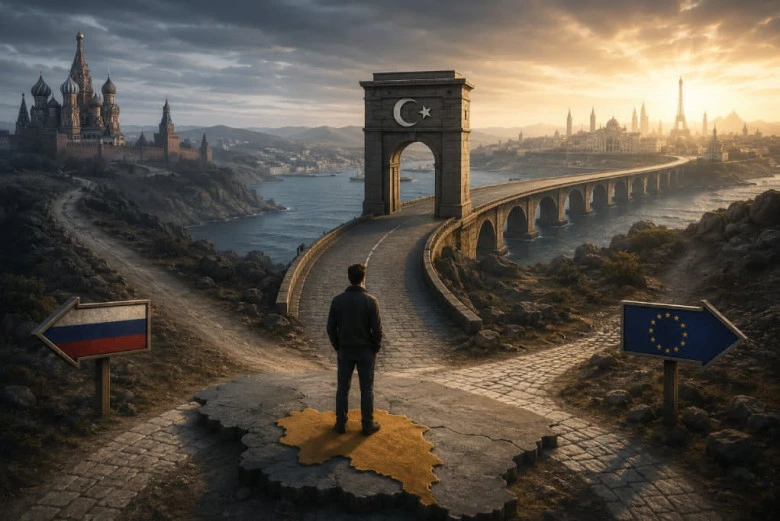
It turns out quite an interesting and at the same time contradictory picture. In public discourse, it is often presented that Armenia faces a choice between Russia and Europe. However, the geographical and infrastructural realities show that, at least in the economic sense, the alternative to the Russian direction in many cases is not directly Europe, but Turkey.
The connection with Europe will largely pass through Turkish corridors, Turkish infrastructure and communication channels under Turkish control. Therefore, changing the poles of influence can lead not to the elimination of addiction, but to a change in the nature of addiction.
This does not mean that Armenia should abandon the development of relations with the West. On the contrary, the deepening of cooperation with Europe and the United States can be important for the modernization of the economy, education, technology, investment, public administration and many other areas. In the modern world, small states cannot afford a foreign policy limited to one direction.
Diversified relationships are often an important factor in security and development. However, the success of foreign policy does not depend on emotional choices, but on realistic calculations.
The deepening of relations with the West and the expansion of cooperation with the European Union should be considered as an important direction, but not as a process that can turn into a realistic perspective of full European integration or membership in the near future.
The process of enlargement of the European Union itself is extremely complicated and long even for those countries that have a direct border with the EU and have been implementing relevant reforms for decades. In addition, it is necessary to take into account another important circumstance. Europe and the United States may be important partners, but they are not in the South Caucasus.
Meanwhile, Turkey, Russia, Iran and other actors in the region are here, directly involved in regional processes and have the ability to react quickly. This reality cannot be ignored in the construction of foreign policy.
History shows that one of the biggest dangers for small states is the wrong assessment of their own capabilities and the external environment. When policies are built on the basis of desired ideas rather than existing realities, risks of strategic mistakes arise. For Armenia, the development of relations with the West is an important and necessary direction, but this should not turn into an idea that joining the European Union is a realistic agenda for the near future.
A policy that simultaneously takes into account the country's geographical position, the regional power balance, the structure of economic communications and the long-term national interests of Armenia can be more effective.
Therefore, in the ongoing discussions about Armenia's foreign policy, perhaps not geopolitical romanticism, but strategic realism is more important.
ARTHUR KARAPETIAN Details in today's issue of "Past" daily