




Archaeologists have discovered the remains of a luxurious private bath complex in eastern Serbia that belonged to Roman Emperor Maximinus Daza, Live Science reports.
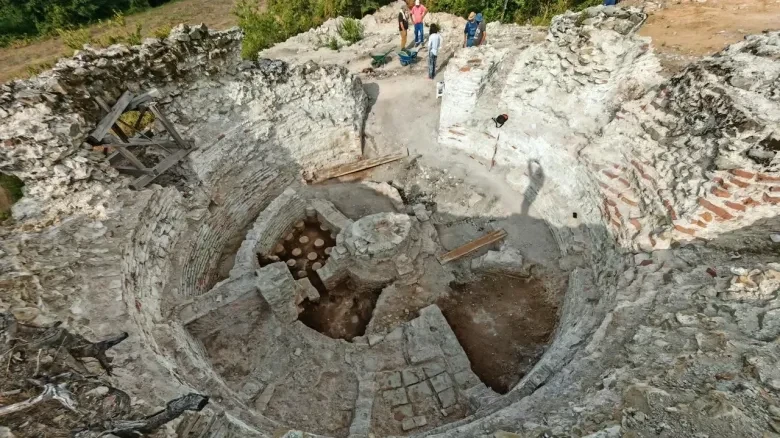
The unusual structure of the baths, located on the lower level of the tower of the imperial palace, has not previously been encountered by researchers of the Roman Empire.
The find was made at the Vrelo-Sharkamen archaeological complex, a monumental fortified residence built in the early 4th century. The palace is associated with Galerius Valerius Maximinus, better known as Maximinus Daza, who was Roman emperor from 310 to 313.
The layout of the baths has aroused particular interest among archaeologists. Unlike most known Roman baths, whose halls were usually arranged in a row, the Vrelo-Sharkamen complex had a circular layout. Above it was a domed ceiling with six windows, which testifies to the high level of engineering knowledge of the Roman builders.
The baths consisted of two main parts. In one was the equipment necessary for their work: archaeologists discovered a stove that was used to heat the floor, as well as the base of a copper boiler intended for heating water. The boiler itself has not survived to our days.
The second part was intended directly for the emperor and his entourage. Here, researchers discovered three pools or baths, as well as a sudatorium - a hall for steam procedures, that is, a Roman sauna.
According to researchers, the complex was not intended only for hygiene. It was a carefully designed private bath for the upper class, where architecture, heating and comfort were combined in one complete structure.
Maximinos Daza was born in what is now Serbia and was one of the participants in the tetrarchy, a system of government established by Emperor Diocletian at the end of the 3rd century. Within this system, several rulers ruled the Roman Empire simultaneously. Later, the system collapsed, and Daza entered into a struggle for supreme power with other claimants. After his defeat in a civil war with Licinius, he died in 313.
Archaeologists will continue to study the complex to find out how the halls of this unusual thermae were connected to each other and how the emperor and his family used the baths.