





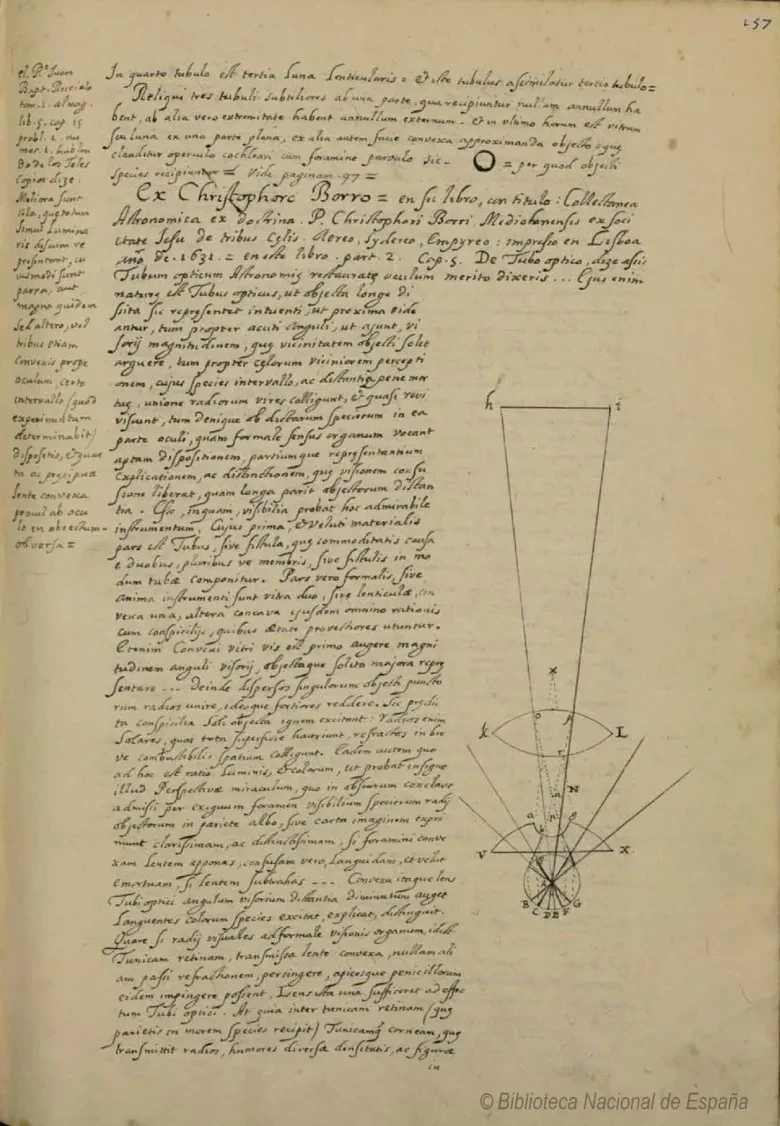
A previously unknown 17th-century telescope description could fundamentally change the history of early optics and the understanding of Galileo Galilei's experiments. A researcher at the University of Limerick has discovered a detailed description of a four-lens terrestrial telescope in a Spanish manuscript, which the author of the document calls Galileo's own creation.
The 1666 manuscript was discovered by Dr. José María Moreno Madrid, a researcher at the School of History and Geography at the University of Limerick. The document, titled De Tellescopiis Stellarum, belonged to the Spanish Dominican friar Ignacio Muñoz.
In it, Muñoz provides a detailed description of the telescope's construction, including its individual components, and directly calls the device "fabricatum a Galilaeo" - "made by Galileo." The manuscript also contains diagrams and drawings of the telescope.
Moreno Madrid's research was published in the scientific journal Annals of Science. Its results show that experiments with four-lens telescopes could have begun much earlier than previously thought.
Historical data usually attribute the appearance of the first four-lens telescopes to approximately 1643–1645. And if the device described by Muñoz was indeed made by Galileo, then the first known experiments with such a structure should be dated no later than 1630, that is, during the lifetime of the famous scientist.
It is particularly interesting that the four-lens design was different from the telescope that later came to be called the Galilean. The device described in the manuscript was a terrestrial telescope with four lenses, an inverted conical body, and a direct-image eyepiece. The lenses were convex and were spaced approximately equal to their two focal lengths.
The history of this instrument is connected with the Spanish colonies. According to the manuscript, the telescope was given to Muñoz by Antonio Sebastián de Toledo Molina y Salazar, Viceroy of New Spain and Marquis of Mancera. The viceroy instructed the monk to carefully examine the device in order to verify its scientific capabilities.
Earlier, Muñoz had been exiled in Portuguese India after attempting to found a new Dominican order in the Philippines. He later approached King Philip IV of Spain with a proposal for a revolutionary method to improve the navigation of the Spanish fleet. In return, he hoped to receive the monarch's support in returning to Spain.
The Viceroy of New Spain suspected that Muñoz might be exaggerating his scientific abilities in order to obtain royal funding. For this reason, he commissioned him to conduct a detailed examination of the telescope.
The find is particularly important due to the lack of reliable information about Galileo's surviving telescopes. The scientist himself claimed that he never sold his telescopes. Of the eight telescopes from the first half of the 17th century that have survived to our days, none can be unequivocally attributed to Galileo. Two instruments in the Florence Museum are traditionally attributed to the scientist, but this attribution remains a matter of dispute.
In addition, Galileo himself did not leave technical descriptions of his telescopes.
It is known that he gave one large and two small telescopes to the Spanish King Philip IV, hoping to gain the favor of the royal court and receive a reward for solving the so-called longitude problem, the problem of determining the longitude of a ship at sea.
Moreno Madrid suggests that the four-lens telescope described by Muñoz could have reached the Marquis de Mancera through the Spanish royal court. However, direct documents confirming this path of the instrument have not yet been found.
The researcher emphasizes that it is still impossible to definitively establish the telescope's belonging to Galileo. However, the combination of the direct writing in the manuscript and the historical evidence that Mancera may have had access to Galileo's telescopes through the Spanish court makes such a hypothesis worthy of serious consideration.
Even if further research does not confirm the instrument's Galilean origin, Muñoz's manuscript remains an important historical source. It contains one of the most detailed technical descriptions of a 17th-century telescope known, and shows how prestigious scientific instruments they were in that era.
Now, researchers hope to uncover new documentary or material evidence that will allow them to definitively determine the origin of this unusual telescope.