





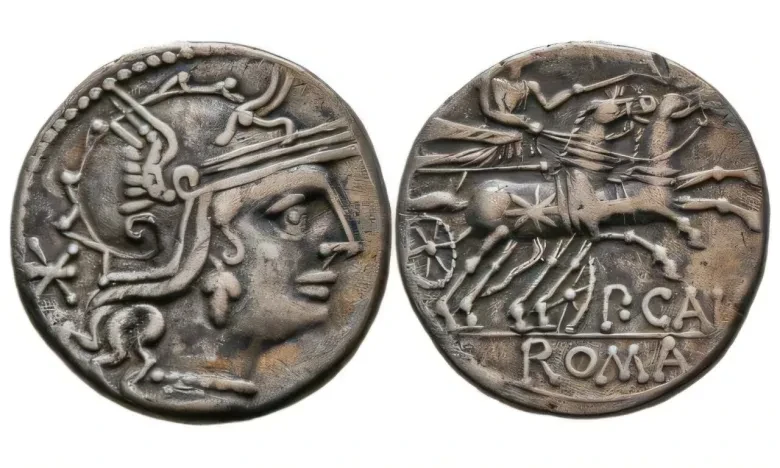
The analysis of nearly 4 million ancient Roman coins has allowed scientists to trace how money spread throughout the Roman Republic and how conquered lands were gradually incorporated into a unified economic system. The results of the study, conducted by scientists from the University of São Paulo, were published in the scientific journal Humanities and Social Sciences Communications.
Researchers Eduardo Amaral Haddad and Inacio Fernández Araujo studied data on coins found during archaeological excavations over the past two centuries. The analysis covers the period from 155 BC to 2 AD, a period of extensive expansion of Roman influence in the Mediterranean.
For the work, the scientists combined information from several international digital archaeological databases. For each coin, the place of minting and the place of discovery were taken into account. As a result, the researchers obtained data on about 4 million coins, collected from 24,646 hoards and linked to 5,167 pairs of minting and discovery sites.
Such a volume of data allowed us to consider the coins not as separate archaeological finds, but as unique signs of economic ties. Spatial analysis showed that the distribution of coins was not at all random: they were concentrated along the main trade routes, roads, ports and major cities of the Roman world.
The spread of coins minted in Rome was particularly evident. Their locations gradually moved away from the place of minting, and the distribution routes largely coincided with the network of Roman roads.
The researchers came to the conclusion that the infrastructure created by Rome performed not only a military or administrative function. Roads and ports simultaneously became channels for the spread of monetary and trade relations, connecting increasingly distant regions.
One of the main results of the work was the clarification of the role of the Roman army in this process. It is believed that it was the legions that largely contributed to the spread of money in the conquered territories: the soldiers received salaries, and the army created demand for goods and services.
However, the analysis of the coins showed that the military presence was only the initial stage. After the conquest of the territory, the creation of permanent economic and social institutions was required for stable monetary circulation.
“Military expansion introduced monetary circulation, but it was strengthened only after the territories were effectively integrated into the Roman world,” the researchers note.
This was facilitated by the development of cities, markets, administrative and religious centers, as well as permanent trade ties. As the new territories stabilized, the share of expenses related to the army decreased, and civil, administrative and commercial operations became increasingly significant.
Another important result was the changing role of geographical distance. In the early periods, coins were more often found relatively close to the minting sites. As the republic expanded, they began to be found at greater and greater distances. Statistical analysis has shown a gradual decrease in the influence of distance on the movement of money.
According to scholars, this indicates the formation of an increasingly integrated economic system, in which areas previously separated by considerable distances and geographical barriers were united by transport networks, markets, and institutions.
Researchers have identified several economic zones. At the center was Rome, where state spending played a significant role. Italy represented the most integrated economic core, where market operations prevailed. Next was an intermediate zone, where military, administrative, and economic spending were combined.
In later conquered territories, the initial expenditure was dominated by the military presence and the strengthening of Roman power. After these regions were stabilized, military expenditure was reduced, while trade, civil administration, and other economic processes increased in importance.
Thus, the study shows that the expansion of the Roman Republic cannot be explained solely by military conquests. The army paved the way for expansion, but it was economic integration that helped Rome consolidate control over new territories for a long time. The millions of coins that have survived to this day have allowed scholars to literally trace this process on a map across the ancient Mediterranean.