





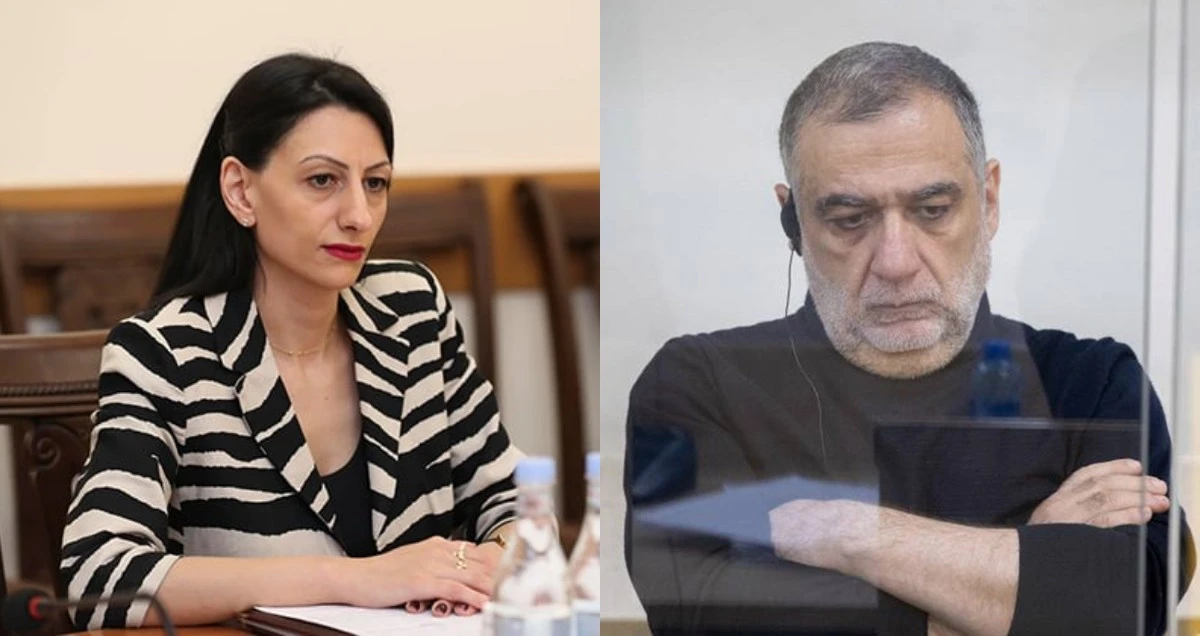
"Zhoghovurd" newspaper writes: "Zhoghovurd" newspaper wrote months ago that proceedings were initiated against Human Rights Defender Anahit Manasyan in the Corruption Prevention Commission. In response to the daily's inquiry, the Corruption Prevention Commission officially confirmed the information. "On the basis of the citizen's application, the Commission initiated a proceeding against the Human Rights Defender based on the apparent violation of the rules of conduct, which is currently in progress."
The commission also noted that the proceedings concern sensitive data related to the personal and family life of private individuals, so other details are not subject to publication. "Zhoghovurd" daily has the materials of the proceedings, however, taking into account that the topic is of a personal nature, we refrain from publishing it.
"Zhoghovurd" daily learned that the examination of the proceedings of September 30, as such, was not even held. The reason was not that the complaint was groundless, or that the Corruption Prevention Commission found that HRD did not commit any violations, but for a much simpler and, perhaps, absurd reason, there was simply no quorum in the commission, and the topic was closed.
Let's note that neither the decision to initiate proceedings on September 30, nor its fate, is posted on the website of the CC Commission. What kind of constraint they have, the HRD did not clarify to the "Zhoghovurd" daily from the Central Intelligence Agency. But this is where the most interesting part of the story begins. "Zhoghovurd" daily knows that the citizen's application referred to the fact that, according to the applicant, Human Rights Defender Anahit Manasyan went beyond his constitutional powers and interfered in private family relations by making inquiries and involving structures abroad.
In other words, the Corruption Prevention Commission had to find out whether the HRD has observed the rules of conduct and the limits of its authority.
However, before the commission made any decision, the Human Rights Defender decided to attack. on February 16, 2026, he appealed to the Supreme Constitutional Court of the Republic of Armenia. Anahit Manasyan, the best lawyer of RA, did not dispute the legality of the specific proceedings in the CC, but rather the authority of the Corruption Prevention Commission to conduct such proceedings against him in general.
According to HRD, the Corruption Prevention Commission cannot request explanations of its activities, examine its records or evaluate its decisions, as this interferes with the constitutional independence of the Human Rights Defender. In other words, the HRD is independent and decides by itself how to protect whose rights.
However, the Constitutional Court did not even proceed to the substantive examination of the case. The court recorded that the Human Rights Council applied to the Constitutional Court on the wrong legal basis. While the Human Rights Council claimed in the Constitutional Court that the Corruption Prevention Commission cannot interfere with its activities, the same Human Rights Defender adopted a completely different position when it came to Ruben Vardanyan, an Armenian prisoner of war illegally held in Baku. Let's remember that Ruben Vardanyan publicly appealed to the Human Rights Defender, asking him to deal with the protection of his rights. The HRD office announced.
"The powers of the human rights defender extend exclusively to the processes of recording alleged violations of human rights by RA state and local self-government bodies, regardless of the citizenship of the right holder."
In other words, the HRD itself stated that if the alleged offender is not a state or local self-governing body of the Republic of Armenia, then it does not have the authority to deal with such cases. If the Human Rights Defender declares that it cannot deal with the rights of Ruben Vardanyan, who is illegally detained in Azerbaijan, because it is beyond its authority, then how is it that in another case it got involved in private family relations, made inquiries and intervened in a family dispute going on abroad? If the reasoning in the first case is the lack of authority, then in the second case, on what legal basis were these actions carried out?
If, on the contrary, the HRD has such broad powers, then why are they not applied when it comes to the Armenian prisoners of war held in Azerbaijan? These questions are still unanswered.
Hopefully, HRD will publicly clarify the issue related to these double standards."