




"Fact" daily writes:
In European political arenas, some leaders receive strong support and political encouragement, while other countries or governments face strong criticism or even political pressure.
When following European political discussions, one can notice that some leaders are often presented as bearers and partners of European values, who deserve sympathy and support. In this context, such figures as Mikheil Saakashvili, Volodymyr Zelensky, Nikol Pashinyan, Maya Sandu, Salome Zuabishvili are often mentioned.
As you noticed, the only thing that unites these people is putting their country's interests on the altar of major geopolitical powers and blindly following the instructions of the West. However, in European political platforms, these leaders are often presented as symbols of democratic changes, and they receive the political support and public attention of European bureaucrats.
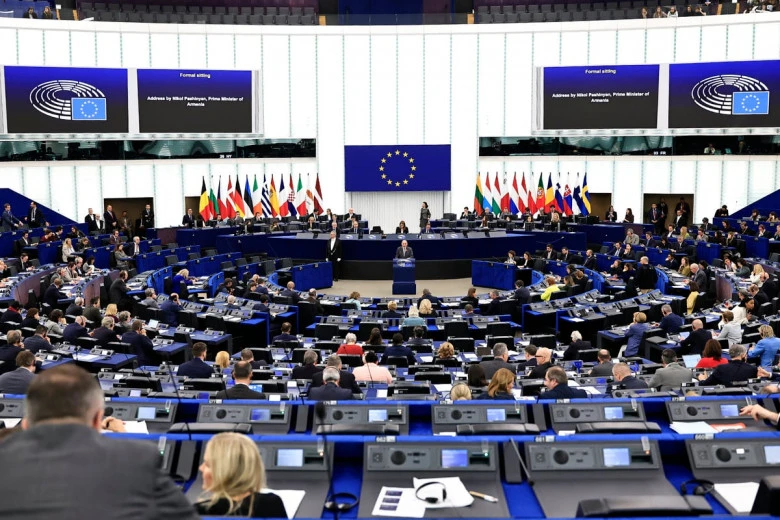
It is not by chance that their speeches, for example, in the European Parliament are applauded. However, in the same period, Europe's attitude towards other countries or other figures can be significantly more critical. This contrast is particularly noticeable in the case of Georgia, especially since there are two former heads of Georgia in the above list.
In European political circles, there is regular dissatisfaction with the fact that Georgia is trying to develop relations not only with European structures, but also to deepen economic and political ties with other countries, for example, Russia and, why not, China as well.
Georgia is trying to advance its interests in the conditions of competition between different geopolitical centers. However, such policies are often viewed with suspicion and criticism in European political circles. When a country (more precisely, a leader of a country, a ruling power) conducts such a policy that coincides with narrow European geopolitical priorities, the attitude towards it is usually more favorable.
And when the government of any state tries to conduct a more multi-vector or diversified foreign policy, political tensions often arise. This phenomenon is characteristic of large geopolitical centers, but in the case of Europe it crosses all borders. Diversified foreign policy is often considered a survival strategy for small and medium-sized states.
When the state is at the intersection of the interests of different geopolitical centers, it is natural for it to try to build relations in several directions at the same time.
Such an approach allows to reduce external dependencies and provide wider economic and political opportunities. However, this is unacceptable for Europe.
It is no coincidence that European institutions often show a more friendly attitude towards governments that are ready to unconditionally support the European geopolitical agenda, even if in the process domestic political or social problems arise, or their own country suffers and becomes a theater of war. Ukraine is the clearest example...
It is against this background that another important question arises: to what extent are the European structures consistent in their value policy? Europe constantly emphasizes that the protection of human rights and the development of democratic institutions are at the core of its agenda. However, critics point out that governments that are considered partners in European politics get carte blanche to do what they want from Europe.
They can take anti-democratic steps and violate human rights, filling prisons with oppositionists, and European institutions will turn a blind eye to what is happening.
This phenomenon is known in international relations as "selective values", when values are not applied on the basis of universal principles, but according to the logic of political expediency. This contradiction is especially felt when the European structures strongly criticize the domestic political developments of some countries, but do not voice the same level of criticism towards the countries that are considered political partners. In such situations, the perception is created that the topics of human rights and democracy are often used as a political tool to exert influence in international relations. And regardless of the fate of the same "partner" states and their peoples...
ARSEN SAHAKYAN Details in today's issue of "Past" daily