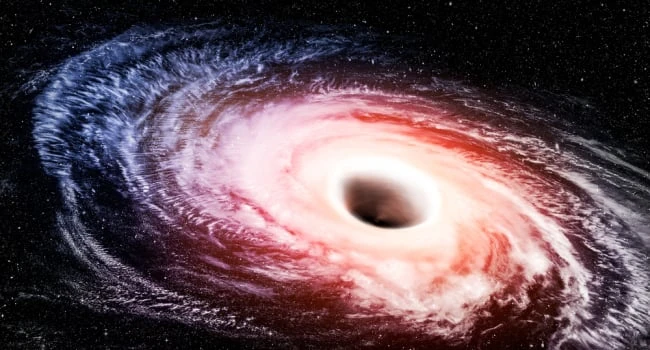





Supermassive black holes can strip their galaxies of the materials needed to form new stars. A study on this, conducted by an international team of scientists using the James Webb Space Telescope (JWST), was published in Nature Astronomy.The team studied the galaxy GS-10578, which is comparable in size to the Milky Way and existed about two billion years after the Big Bang. Like many large galaxies, GS-10578 has a supermassive black hole at its center. However, this galaxy has almost stopped star formation, which makes it effectively “dead”. As co-author Dr Francesco D'Eugenio from the Kavli Institute of Cosmology in Cambridge noted, scientists previously knew that this galaxy was in the process of fading star formation and assumed that this was due to black hole activity, but they could not confirm this connection with certainty until receiving data from Webb. Now scientists are trying to understand whether this fading is a temporary or permanent process.This galaxy was informally named "Pablo's Galaxy" in honor of the astronomer who began to study it in detail. It stands out for its large size for such an early stage of the Universe - its mass is about 200 billion times greater than the Sun.According to Professor Roberto Maiolino from the same institute, in the early Universe, most galaxies were actively creating stars, so scientists were especially interested in finding such a huge galaxy with no signs of star formation. The process that stopped star formation probably happened quite quickly, they suggested. Researchers have found that the black hole at the center of the galaxy is ejecting gas at about 1,000 kilometers per second — fast enough to overcome the galaxy’s gravitational pull. This process is pushing significant amounts of gas out of the galaxy, depriving it of fuel for new stars.It was previously predicted that such a phenomenon could be caused by black holes, but it was only with the help of the JWST that scientists were able to directly observe this process. The telescope found that along with hot gas streams, the galaxy contains cold, dense clouds of gas that do not emit light, but block the light of galaxies located behind them.The scale of the ejected gas is so large that it is enough for the galaxy to continue forming new stars, but the black hole is essentially “starving” its galaxy.Previously, models suggested that the end of star formation could cause chaos in the structure of the galaxy, destroying its shape. However, in the case of GS-10578, its stars continue to move in an orderly fashion, casting doubt on this hypothesis.Scientists plan to use the ALMA telescope to probe deeper into the cold gas components of this galaxy to see if there is any leftover material for future star formation and how much the black hole affects the surrounding space.
What problems can black holes cause for galaxies?
21.09.2024 16:22 |
Category
Science and culture