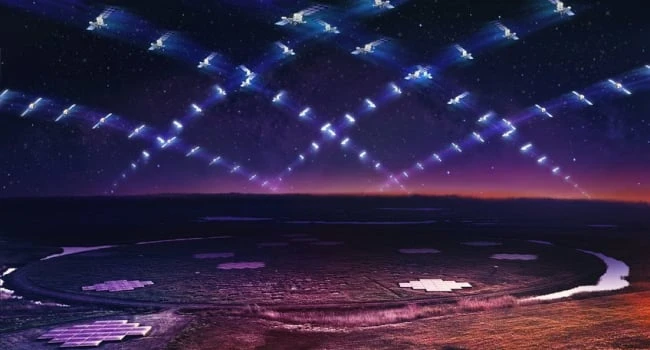





This summer, astronomers from the Netherlands Institute for Radio Astronomy (ASTRON) operated one of the world’s most advanced radio telescopes, LOFAR, for a day and were shocked by the results. The new versions of Starlink internet satellites literally blinded the ultra-sensitive equipment. Their brightness in the radio spectrum was 32 times greater than the interference from first-generation Starlink satellites. Researchers concluded that this could soon destroy all ground-based observational astronomy.“Every time new satellites with these levels of emission are launched, we see less and less of the sky,” ASTRON director Professor Jessica Dempsey told BBC News. “We’re trying to look at things like jets coming out of black holes at the centers of galaxies. We’re also observing some of the earliest galaxies, millions of light-years away, as well as exoplanets,” she explained.Currently, there are just over 6,000 Starlink satellites in low Earth orbit. This network will continue to grow, as will the network of OneWeb (up to 1,000 satellites in orbit), while Amazon prepares to deploy its own constellation (up to 3,000 satellites by 2030). By 2030, experts expect there could be up to 100,000 internet satellites in orbit, which not only threatens astronomy across all wavelengths, including optical, but could also block any ground-based observations of the universe.“This truly threatens all ground-based astronomy at all wavelengths and in various ways. If this continues without mitigating measures to make these satellites quieter, it will indeed become a real threat to the existence of the types of astronomy we do,” added Professor Dempsey.This is not the first warning about the threat communication satellites pose to Earth-based astronomical observations. Starlink, as a pioneer, has made some efforts to reduce both optical and radio frequency interference from first-generation satellites. However, the new satellites are blinding to radio telescopes. Their brightness is 10 million times stronger than the weakest signals detected from the depths of the universe. Researchers explained that it’s like comparing the faintest visible stars to the brightness of the full moon. Such interference cannot be ignored.Without active measures to prevent this, “very soon, the only constellations we’ll see will be the ones created by humans,” experts concluded.
Astronomers are in a panic: New Starlink satellites seriously interfere with radio telescopes
20.09.2024 17:04 |
Category
Science and culture