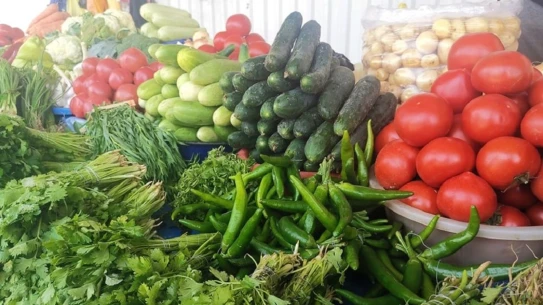





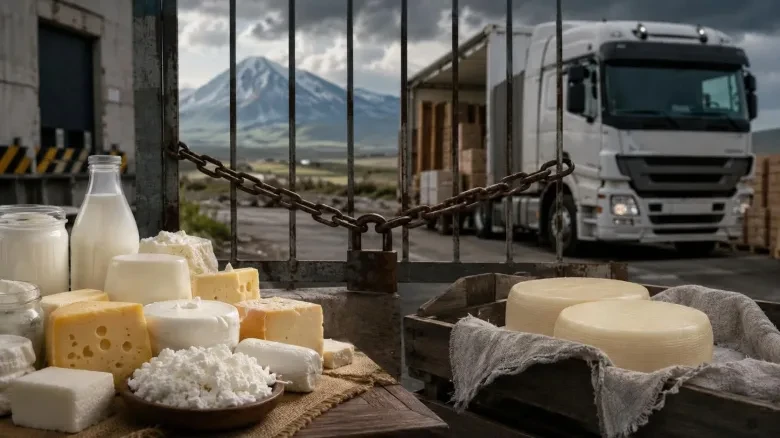
Economist Aghasi Tavadyan is concerned about the economic problems that are deepening day by day in our country. Let's remind: for several months now, Russia has restricted or completely banned the import of many Armenian products into its country, justifying these decisions by the discovery of various violations.
Such actions by Russia were especially active before the parliamentary elections in Armenia and continue to this day. In the context of all this, Tavadyan noticed that the restrictions applied by the Russian Federation are mostly political in nature.
If there were some obstacles before, now they have significantly increased. In a conversation with Euromedia24 TV, Tavadyan mentioned that at the moment about 20 percent of Armenian goods exported to EAEU are actually restricted.
He reminded that one of the fundamental principles of EAEU is the free movement of goods, services, capital and labor between the member states, but in reality at least two of these freedoms, the free movement of goods and capital between Armenia and Russia, do not work today.
"This creates quite big problems in our domestic market, especially if we take into account that after 2018, Armenia's export to the EAEU has increased almost fivefold, while it has not registered a significant increase to the EU. This means that sufficient policy has not been taken in that direction," the economist emphasized.
According to Tavadyan, before the elections, businessmen expected that the Russian restrictions would be temporary, and after the elections the situation would be settled, but these expectations were not justified. According to his assessment, the biggest impact is borne by those producers whose products were intended exclusively for the Russian market from the beginning. According to the economist, some producers have to find detours.
He also considered the state of floriculture to be particularly worrying. The situation of those engaged in the flower business is also critical. most of the cut flowers are sold in the domestic market today several times cheaper than last year, because the main export direction has been closed. As for the government's statements that the European market is gradually opening up for Armenian agricultural products, the economist calls to evaluate the situation not by statements, but by economic calculations.
Tavadyan gave an example of the information spread a few days ago that the Armenian apricots exported to Spain spoiled on the way, because the transportation to Europe is long, and in the case of agricultural products, time is of crucial importance.
He also drew attention to another problem, the limitation of the free movement of capital.
According to him, Russia actually refuses to accept back the rubles accumulated in Armenian banks, which is already affecting both the banking system and the citizens.
"Banks are unable to sell the accumulated rubles, as a result of which the ruble exchange rate in Armenia has decreased significantly. If one or two months ago one ruble was worth 4.6-4.7 drams, now it has reached around 3.9-4 drams," said the economist.
According to him, as a result of the restrictions, truck drivers also faced problems, who used to be one of the important links of ruble circulation, and now they have lost that opportunity as well.
According to Tavadyan, the banks of Belarus are already facing such problems, which have also applied restrictions on accepting rubles. Agassi Tavadyan is convinced that the current situation is not only an economic problem.
It is already causing social consequences, hitting both manufacturers and exporters, the banking system and ultimately the incomes of ordinary citizens.
In his assessment, if Armenia's foreign trade policy is not diversified and the formation of new markets does not become a long-term and systematic state strategy, the country's economy will continue to remain in a dangerous framework of dependence on one market.