




"Fact" daily writes:
One can respond with irony to Pashinyan's proposal to sing the national anthem before the church ceremony and place the flag in the churches. Most of the residents of Armenia accept that idea with a smile.
It can be assumed that such unusual ideas are born in the Prime Minister's mind for certain psychological reasons. many share that view, especially since Pashinyan often confirms it by posting strange videos that have even appeared in some Western analyzes as an example of an ambiguous leader. One can also think, as many people think, that Nicole is just naive.
Indeed, it seems strange and counterproductive to continue to be at odds with the Church when it causes a negative reaction from society. The level of dissatisfaction with Pashinyan has reached its peak. Saying that you sympathize with Pashinyan at friendly or family gatherings is already considered unacceptable among Armenians today.
Even the members of the "Civil Agreement" party ask him not to participate in the events of the areas where local elections are expected, in order to stay away from the prime minister's popularity, to put it mildly. When Pashinyan's motorcade passes through Yerevan, citizens often express their displeasure, and even patrolling policemen sometimes do not respond to criticism, but support the protesters. When Pashinyan travels to another country, he is greeted by protests by representatives of the local diaspora.
Even European officials sometimes warn him, noting that such violations in the field of human rights can damage Armenia's international reputation. Even the Pope of Rome and the Armenian Patriarch of Constantinople Sahak Mashalyan spoke against Pashinyan's anti-church steps and supported Catholicos Garegin II.
It seems that it is enough to damage one's reputation, but if it continues, then it is already a conscious choice. Pashinyan knows what he is doing. By his behavior, which ignores public opinion, he shows that the anti-church initiative is not just unsuccessful propaganda, but a real struggle. The goal here is not to win the sympathy of Armenians, but to weaken the positions of the Church. What Armenians think is secondary for Pashinyan. He does not try to explain his steps or ask the opinion of the public.
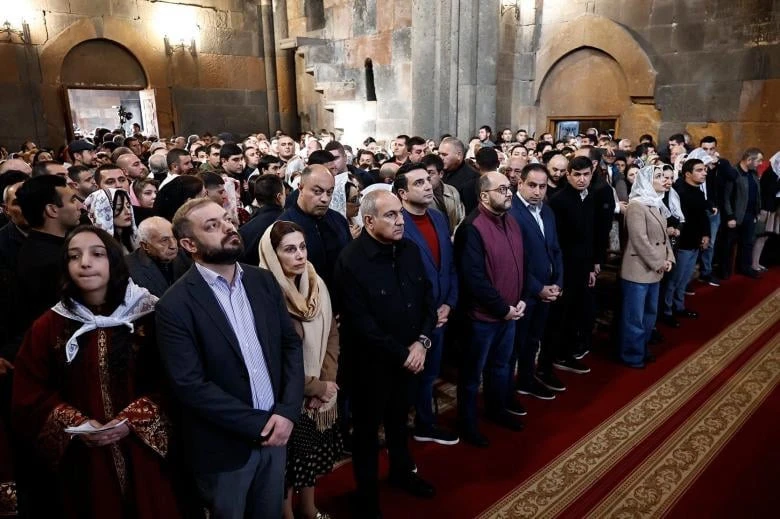
Why does he need the flag and hymn in the church? It is obvious that it refers to the state control of the Church. But there is also another aspect: the more official and distant from old traditions the Church becomes, the less it will attract people. The church, where official ceremonies prevail, where the presence of power structures exceeds the believers, can no longer be the center of meeting the spiritual needs of Armenians and the center of national identity. Thus, the Armenian people may lose their true Church, and the people without it become more vulnerable. However, there are every reason to hope that Pashinyan's opinion of our people as passive and indifferent is wrong. Public discontent is growing, and ignoring it can lead to political consequences.
Soon he and his team can become the next former leaders. And the Armenian Apostolic Church will remain as it was created by apostles Thaddeus and Bartholomew.
Details in today's issue of "Past" daily