




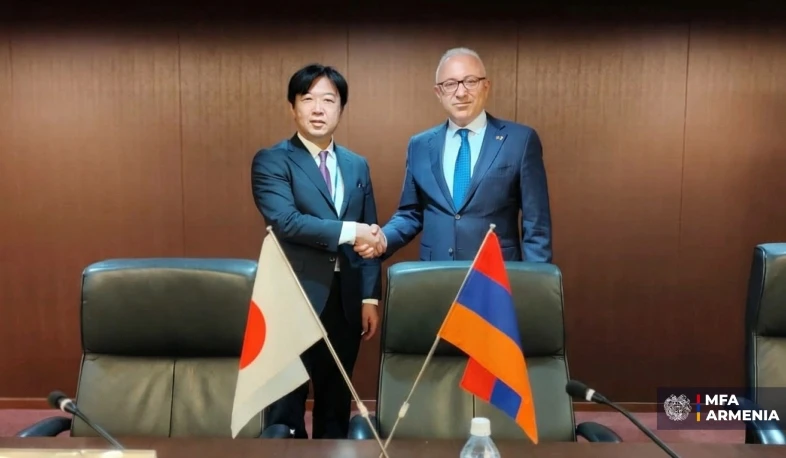
On February 3, political consultations were held in Tokyo between the Ministries of Foreign Affairs of the Republic of Armenia and Japan, led by the Deputy Minister of Foreign Affairs of the Republic of Armenia Mnatsakan Safaryan and Deputy Assistant to the Minister of Foreign Affairs of Japan, Deputy Director General of the Bureau of European Affairs Masaki Ishikawa.
The Ministry of Foreign Affairs informs that during the consultations, the parties discussed a wide range of issues on the bilateral agenda, including the existing dialogue in the political, trade-economic, technological, educational and cultural, tourism and humanitarian spheres, emphasizing the need to develop and expand relations in these spheres. The meeting held last year between the prime ministers of the two countries and the importance of the continuation of bilateral visits were emphasized on both sides.
Referring to cooperation within the framework of international organizations, the parties noted with satisfaction the positive dynamics of cooperation formed on multilateral platforms. In this context, the possibility of cooperation within the framework of hosting the 17th conference of the parties to the UN Convention on Biological Diversity (COP17) in Armenia this year was referred to.
Thoughts were also exchanged on regional realities, in the context of which RA Deputy Foreign Minister Mnatsakan Safaryan presented to his counterpart the developments in the South Caucasus, the steps aimed at the further institutionalization of established peace and the development of regional interdependence, including the acceptance of the implementation framework of the "TRIP Path" project and current processes.