"Fact" daily writes:
One of the most expressive phenomena in the political and social agenda of Armenia in the last period became the unprecedented wave of attacks, pressures and criminal prosecutions against the Armenian Apostolic Church and its high-ranking clergy, the deep causes and consequences of which are beyond the scope of purely legal or personal issues and touch the fundamental foundations of national identity, statehood, public consolidation and value system.
In order to understand the motives and mechanisms of this process, it is necessary to comprehensively analyze both the logic of the behavior of the authorities, the position and role of the Church in the Armenian reality, as well as the dynamics of the impact that this conflict can have on the social structure, historical memory and national resistance.
In different periods, especially in the absence of statehood, the Church took on a nationalistic, educational, charitable, cultural and even political role, and during the period of independence, it turned into an important factor of national identity preservation and public consolidation. It is in this context that the government's openly hostile policy towards the Church and clergy should be considered in recent years, starting from propaganda campaigns, attempts to discredit the public, to legal prosecutions, criminal cases and arrests of clergy.
First of all, it should be stated that the attacks against the Church are not merely the result of the personal behavior of one or several clergymen, alleged offenses or political activity, but are a conscious and systematic part of the state policy. The basis of this process is the strategy of the authorities to discredit national institutions, weaken the pillars of public identity, transform the value system and neutralize the traditional mechanisms of social consolidation, which is covered by various false "ideas" and narratives.
For the authorities, the Church is not only a competing ideological center, but also an institution with influence in public and political life, whose further weakening or isolation is seen as a way to strengthen their own power, especially in the context of making concessions to external forces. In this logic, the high level of public trust towards the Church is of key importance. In the history of Armenia, there have been many cases when the Church has acted as a unifier, bearer of moral values and a source of national resistance in the conditions of public crises, wars, threats to statehood.
Today, when the authority of political institutions is undermined, the party system is weakened, and the state administration system is in crisis, the Church remains one of the unique structures around which different layers of society can unite. This is perceived as a serious danger for the authorities.
In addition, the Church, being the most important institution of national unity, patriotism, historical memory and identity, with its positions and statements often puts forward a critical agenda towards state policy, raises public concerns, defends the rights of Artsakh and Artsakh Armenians and shows resistance to attempts to devalue national values, history and culture.
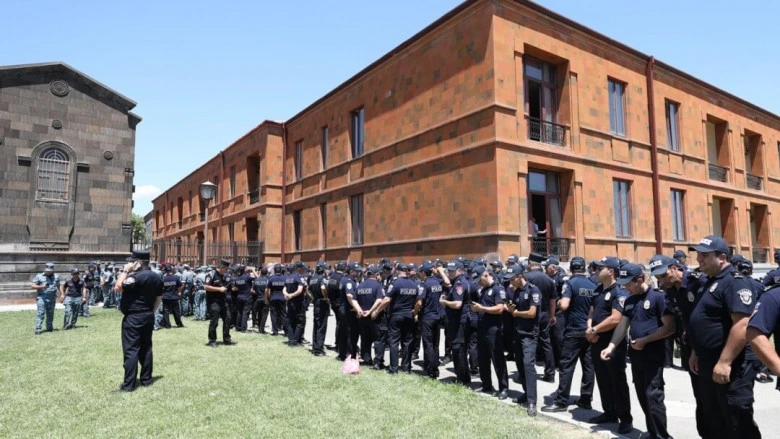
The practice of criminal prosecutions and arrests against clergymen speaks for itself that the authorities are not limited to ideological attacks, but use open pressure to silence them, as evidenced by recent cases of criminal prosecutions against high-ranking clergymen.
Most (if not all) of the cases brought against the clergy are based solely on political motivations, and the legal processes are accompanied by public hysteria and campaigns organized by government information platforms, the purpose of which is to discredit not only the given person, but also the entire clergy and the Church in general.
And now, after all this, Nikol Pashinyan declares that he is not attacking the Church, and the Catholicos or bishops are not the Church. This is more than cynicism. First of all, even under his denial, the actual Pashinyan makes a self-confession that the persecution of churchmen is carried out on his personal orders.
In other words, he is at war against the clergy, not the Church. But the funniest thing is that the Catholicos is separated from the Church by a man who declares that he is the government. This is simply absurd. Just as it is absurd that Pashinyan's government identifies itself with the state or statehood in general.
That's why, when criticisms are heard or steps are taken against the corrupt policies of the authorities, as a result of which the inalienable rights of the Armenian people are put on the altar and unspeakable concessions are made to foreign powers, then immediately the hoodlums, led by Pashinyan, start making noise that various "anti-government" forces are working against the state.
On the other hand, both Pashinyan and his team are only temporary rulers who only solve the issue of keeping their seat under the ideas of statehood and sovereignty, they are very little interested in what will happen to the state. And if they had thought otherwise, they would have voluntarily left a long time ago and thus at least they would not have allowed hostile and, in general, other external forces to "gamble" on the fate of our country.
And the Church has more than a connection with the state and statehood, because, as we have already mentioned, in the absence of the state, it took over the functions of statehood and over the centuries created the necessary basis for the restoration of statehood. And even now, the Church raises its voice when it sees the threat to statehood and the vital interests of the Armenian people.
And the attacks, arrests and attempts to discredit the Church and the clergy are a serious threat not only to the Church, but also to the continuity of the entire Armenian people, national identity and statehood. So, the Pashinyan campaign against the clergy is definitely an attack and a war declared against the Church, the state and the state in general. And not only this campaign...
ARTHUR KARAPETYAN Details in today's issue of "Past" daily