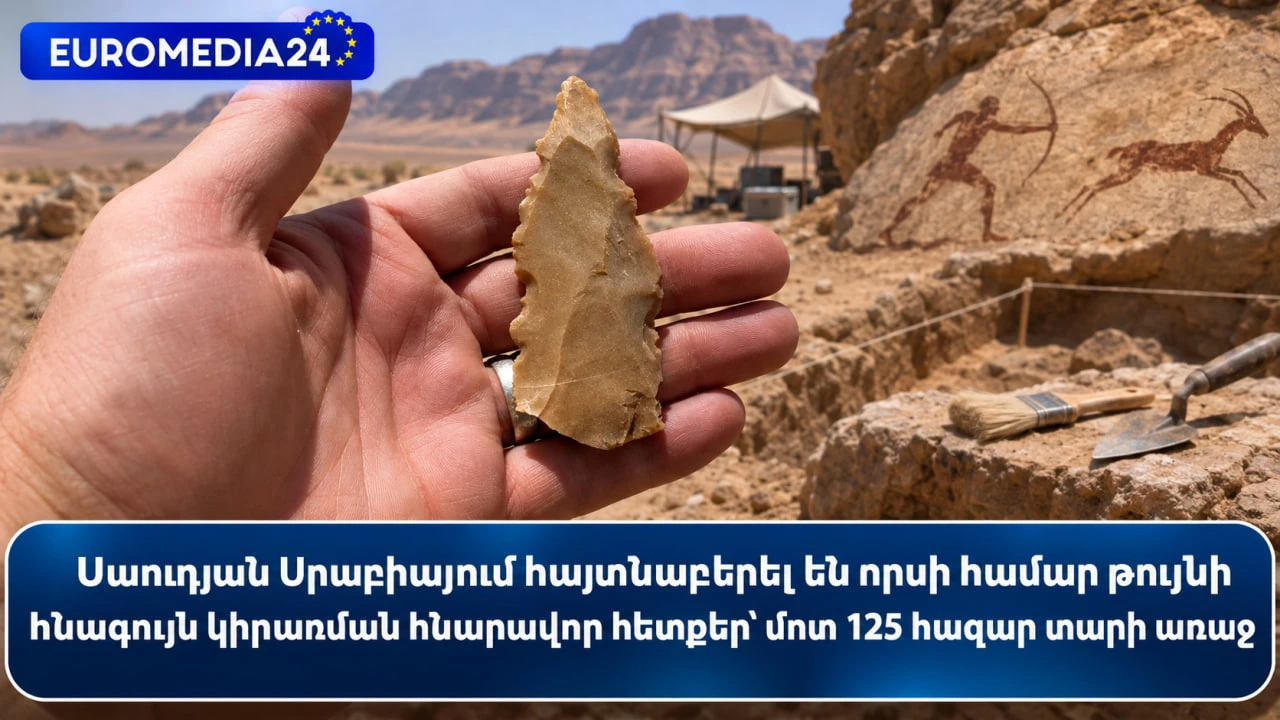
Archaeologists have discovered stone tools in present-day Saudi Arabia that retain traces of materials related to a poisonous plant. The findings may indicate that ancient humans used poisoned weapons for hunting as far back as about 125,000 years ago. If confirmed, this would be the earliest known evidence of the use of hunting poisoned tools.
The study was published in the journal Science. Scientists examined the prehistoric site of Uruk al-Jaliba in southern Saudi Arabia. Today, this area lies within the Rub' al Khali, one of the world's hottest and driest deserts.
However, about 125,000 years ago, there was a freshwater lake here covering about 340 square kilometers with a depth of 29 meters.
Based on fossil remains, researchers determined that the lake's surroundings featured a rich animal and plant life. Hippopotamuses, buffaloes, ostriches, camels, deer, and oryxes roamed here, while junipers, trees, and shrubs thrived. Ancient humans utilized these resources for food procurement and other needs.
More than 5,500 stone artifacts were found at the site, along with well-preserved remains of plant materials such as fibers, resin, and wood. Some stone points bore characteristic damage typical of hunting large animals. Microscopic analysis revealed traces of animal tissue on their tips. The placement of tools coincided with bone accumulation zones, indicating that the lakeshore area was used for hunting and butchering game meat.
Particular interest was aroused by chemical residues found on several stone points. These were linked to the poisonous plant Acokanthera schimperi, which grows in East and Central Africa as well as the southern Arabian Peninsula. Historically, African hunters used extracts of this plant to treat the tips of arrows and spears; the toxins it contains can paralyze or kill animals.
"These finds dating back 125,000 years are significantly older than the arrow tips with poison residues recently found in South Africa, which are about 60,000 years old," said co-author Chris Clarkson, an archaeologist at the Max Planck Institute for Geoanthropology in Germany and Griffith University in Australia.
Nevertheless, the researchers emphasized that it remains unclear how ancient hunters prepared the poison and how effective it was.
It also remains an open question how hunters avoided poisoning themselves when consuming the hunted meat. According to Clarkson, the effect of poison depends on the substance, dosage, and route of entry into the body. Poison introduced directly into a wound may not have the same effect if ingested orally. Historically, hunters sometimes removed the meat around the wound before consuming the remaining meat of the animal.
The discovery also offers a new perspective on the technological abilities of ancient humans. They not only made stone tools but could combine stone with wood, plant fibers, resins, and possibly poisonous substances, creating complex tools and weapons.
The Arabian Peninsula is located between Africa and Asia and played an important role in human dispersal. During periods of increased moisture, its today-arid areas became habitable landscapes connecting the two continents. The site's age aligns with known evidence of Homo sapiens presence in Southwestern Asia during that period. At the same time, no human remains have yet been found at the site.