




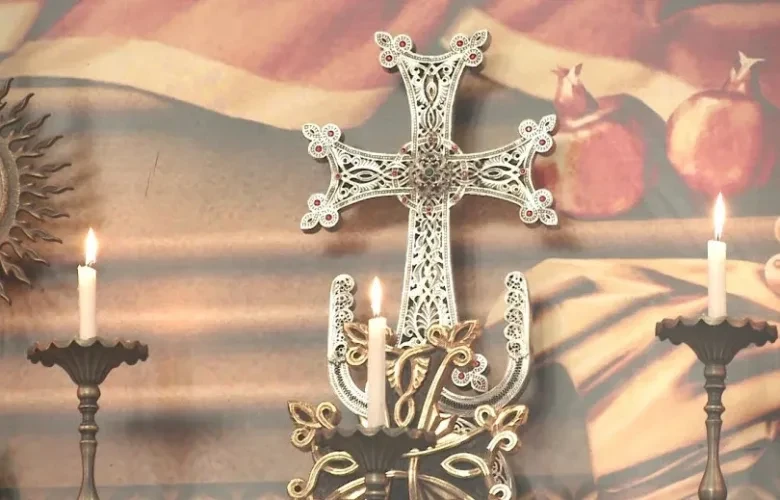
Khachverats is the last of the five feasts of the Armenian Apostolic Church. The Armenian Apostolic Church Khachverats celebrates on Sundays between September 11-17.
It is the most important of the feasts dedicated to the Cross, dedicated to the memory of the return and glorification of the cross from captivity.
The Holy Cross is celebrated in commemoration of the Lord's return to Jerusalem from the Persian captivity and the erection (removal) at Calvary.
After the invention of the Holy Cross, Queen Helena built the "Holy Resurrection" temple on Golgotha by the order of the Holy Emperor Constantine and erected the Lord's staff there, and also built temples and chapels in Bethlehem and other administrative places. The queen ordered to celebrate eight days with great solemnity at the port of the holy temples.
From that day on, it was established to celebrate the Dockyard of the Cross and the Feast of the Church every year on September 13, and the Feast of the Cross on September 14.
On that day, following the example of Hakobos Tyarneghbor, the high priest raised the cross of the Lord for the protection of the believers, that's why the holiday was called "Kachverats".
The Khachveratsi festival received its final approval later, when the king of Persia, Khosrow Ambarisht, who had reached the peak of his power, in 610 wanted to subjugate the emperor Herakles and in a letter offered him to come, accept his superiority and worship him. He, giving a great army to his general Khorem, sent him to the Greek world, and the latter began to destroy and take great spoils from the world of the Palestinians.
Horem the general in 614, besieging the city for nineteen days and digging its foundations, captured it. When the Persian army entered the city, the entire population was put to the sword. 57,000 people were slaughtered and 35,000 people were taken captive, including Patriarch Zacharias, then the Persians entered the Holy Resurrection Cathedral, confiscated the Holy Cross of the Ascension and the gold and silver vessels of the temple, and burned the city.
Then the commander ordered the captives to rebuild the city and expel all the Jews, and he took the Honorary Cross to Persia. As the army approached the royalist city, King Khosrow came forward to meet the Lord's Cross, from which the Cross of Christ was inadvertently glorified.
When the Cross of Christ entered the city with such honor, the Persian king kept it in great honor in his treasury and kept an undisturbed cantilever in front of the Cross.
Locals treated the cross of the Lord with great fear and said that the God of Christians came to them.
History documents that on the way back to Jerusalem, the Cross stopped for some time in the city of Karin. On that occasion, the big peak of the mountains rising on the southeast side of the Karno field is called Khamirayt. At the foot of the mountains of the same name is the Khachka monastery. From the place where the cross is placed, a beautiful spring flows, around which basil grows. This tradition also became the reason for establishing the order of blessing basil during Khachveratsi holiday.
At the end of the ceremony, the blessed basil is distributed to the faithful.
In folk tradition, Khachverats or "Serbkhech" is a joyful holiday symbolizing the beginning of autumn. On the eve of the holiday, on Saturday, women make pastries, men butcher and prepare gorovi.
According to folk tradition, uli meat and semolina pilaf are the special foods of that day, without which the holiday cannot be complete.
The day after the Cross is the Day of the Dead. On that day, a liturgy is served in churches, a memorial service is performed, after which the graves of the deceased are visited.
The Armenian Apostolic Church has the following holidays dedicated to the Holy Cross: Apparition of the Holy Cross, Khachverats, Varaga St. Khachi, S. Invention of the cross. Three of these four are celebrated in all Christian churches, and only the holiday of the Varaga Holy Cross is purely Armenian and is celebrated only in our Church.