





"Zhoghovurd" daily writes:
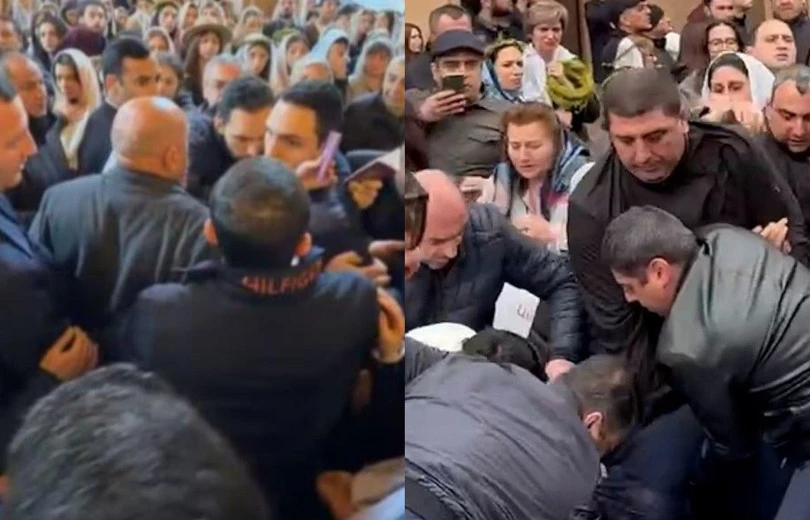
"KP members, naturally, started targeting young people who dared to express their displeasure over the delayed entry of Nikol Pashinyan. Let's note that international experience shows one important thing: public provocative and even physical actions against political leaders, prime ministers, presidents or other high-ranking officials do not always lead to the same serious consequences in different countries. In some cases there is a quick arrest and conviction, but there are also examples where people have been released without charge, or the sentence has been clearly lenient. It follows from the public descriptions of the St. Anna incident that the tension started during the liturgy against the background of the Prime Minister's presence, the behavior of the entourage and the uncomfortable atmosphere in the church.
Then there was a scuffle, after which the Prime Minister left, and less than an hour had passed when the police detained three people from the church yard. What kind of similar cases were there in the world, when citizens showed aggression towards the government, and what was the outcome of the incidents?
In 2019, Australian teenager Will Connolly smashed an egg over Senator Fraser Anning's head after the latter blamed immigration for the tragedy following the Christchurch mosque attacks. In 2010, shoes were thrown at Pakistani President Asif Ali Zardari during a protest. The Guardian wrote that the police removed the man from the place, but no serious criminal charges were filed.
That episode is significant in that even with presidential-level targeting, the response did not turn into a story of direct, demonstrative severe punishment. In 2009, Reuters wrote that a journalist threw a shoe at Indian Interior Minister P. In Chidambaram's direction, after answering his question on the 1984 pogroms case. Again, there were no serious consequences. In 2008, Iraqi journalist Muntazer al-Zaidi threw shoes at US President George W. Bush during a press conference in Baghdad.
Reuters reported that he was initially sentenced to three years in prison, later reduced to one year, and later released nine months later, early. In 2021, the man who slapped French President Emmanuel Macron during a public meeting was sentenced to four months in prison. In 2024, a woman in Great Britain who threw a banana milkshake at Nigel Farage was charged, but according to Reuters, she received a suspended sentence, not an immediate prison sentence. On November 3, 2024, King Felipe VI of Spain, Queen Letizia and Prime Minister Pedro Sánchez visited the flood-affected village of Paiporta in Valencia. According to Reuters, hundreds of residents protested against the reaction of the authorities, and some of them threw mud at the officials.
Press coverage focused not so much on demonstrative criminal prosecution as on failure of disaster management, public outrage, and government accountability. What does the comparison show? These examples do not mean that any incident should necessarily go unpunished. But they show one simple fact. international experience is not uniform, and an incident against a high-ranking official or leader does not automatically mean harsh criminalization, long detention or demonstrative prosecution.
After all, there was a similar incident in Armenia, when a grandfather from Artsakh threw an apple at Pashinyan and was acquitted."