




"Hydrometeorology and Monitoring Center" Director Levon Azizyan wrote on his social media page:
"Where does the weather go "crazy"? TOP-5 countries with climate anomalies. We are used to complaining about a sudden downpour or summer heat, but there are places on the world map where the concept of "bad weather" takes on truly terrifying proportions. Here, the sky is torn by millions of lightnings, the rains can last for years or not even centuries, and the air is saturated with volcanic heat.
Venezuela: empire of eternal storm
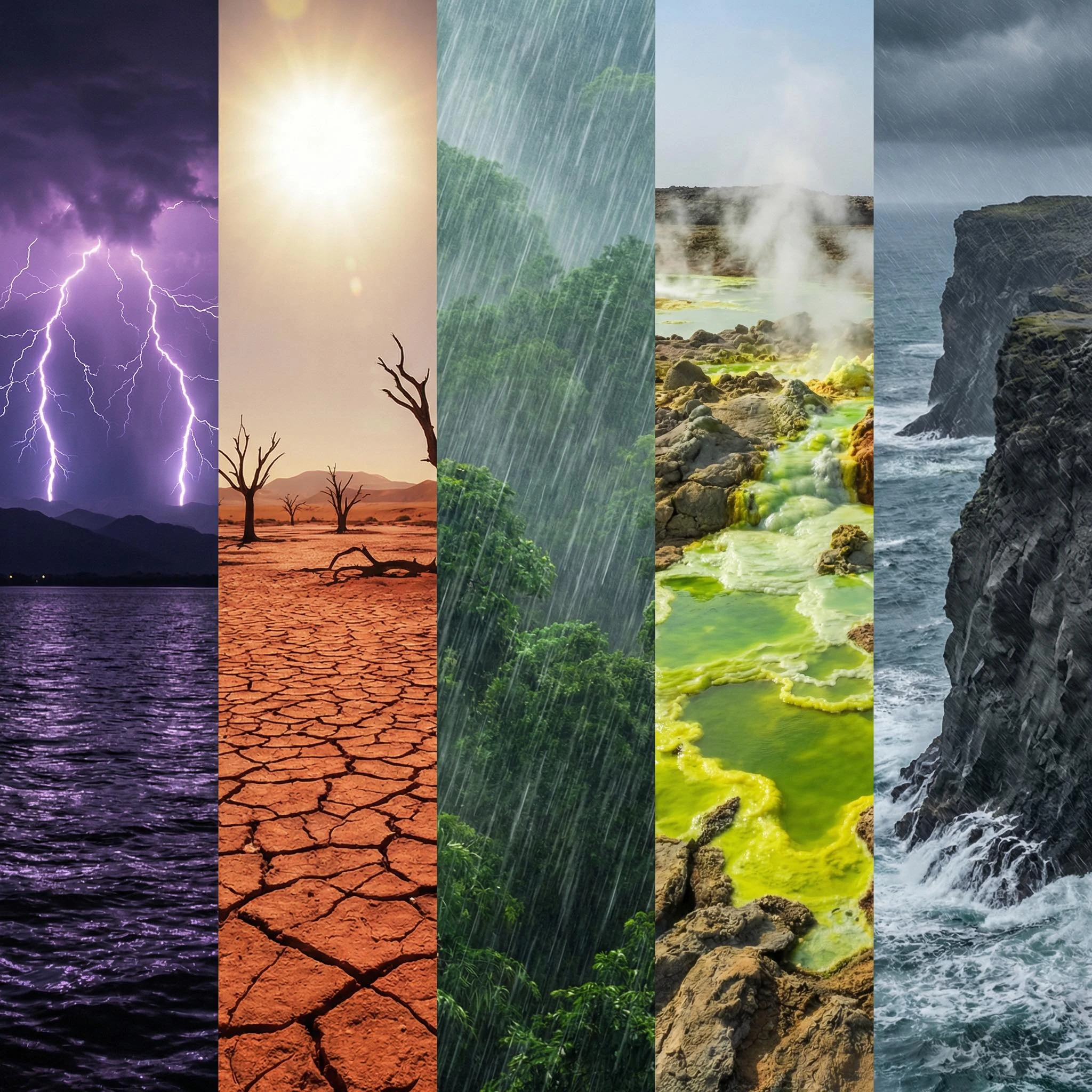
If you are afraid of thunderstorms, you should definitely not approach the mouth of the Catatumbo River, which flows into Lake Maracaibo. This region of Venezuela is rightfully considered the lightning capital of the world. A unique atmospheric phenomenon known as "Lightnings of Catatumbo" is observed here. This is not just a thunderstorm, but an almost non-stop electrical storm that can last up to 160 days a year, for about 10 hours each night. The unique topography of the place creates an ideal aerodynamic "tube". Warm and moist air currents coming from the Caribbean collide with cold air coming down from the Andes, causing strong ionization. The sky here flashes almost 300 times an hour. The light is so strong that it can be seen from a distance of more than 400 km and has historically served as a natural beacon for seafarers.
It is noteworthy that these lightnings are hardly accompanied by thunder, since they occur mainly between the clouds at high altitudes, rather than striking the ground. Locals have adapted to the conditions of living under the stroboscope of this nature, but for an unprepared tourist, the nights of Lake Maracaibo can become a real psychological test. it feels like the sky is literally opening up above your head.
Chile: land of utter thirst
In the north of Chile is the Atacama Desert, a place that climatologists consider the driest place on Earth. The paradox of the local climate is that, being located on the coast of the Pacific Ocean, this area does not see rain for centuries. The cold Humboldt Current cools air over the ocean, creating an inversion layer that prevents rain clouds from forming, and the Andes block moist air masses from the Amazon basin. As a result, meteorological stations in some parts of the Atacama have never recorded rainfall in history. The local landscapes are so reminiscent of "alien" that NASA uses this place to test Mars rovers. Due to the lack of moisture, the air is almost sterile. organic remains do not decompose, but mummify naturally.
However, even in this realm of perpetual drought, climatic miracles sometimes occur. Every few years, under the influence of the El Niño phenomenon, the rains reach the desert. At that time, the uninhabited sands are suddenly covered with millions of purple and pink flowers. This phenomenon, known as the "Blooming Desert", lasts only a few weeks, after which the earth falls back into a perennial slumber.
India: life under the waterfall
If the Atacama is the pole of dryness, then the Meghalaya state of India, particularly the village of Mausinram, is the pole of humidity. This region is officially recognized as the rainiest place on the planet. The humid monsoons from the Bay of Bengal collide with the Shillong plateau and, having no way to move forward, dump all the moisture on this small area.
The average annual amount of precipitation here exceeds 11,000 mm, which is tens of times more than in rainy London or St. Petersburg. Locals live in constant "shower" conditions. During the monsoon season, it can rain for weeks without stopping, and the noise of the water hitting the roofs is so loud that people have to shout to hear each other.
Normal umbrellas are useless here because of the strong winds, so "knup" - large shields made of bamboo and banana leaves - are used. The humidity is so high that bridges are not built over rivers, but are grown from the roots of rubber trees, as wooden or metal structures rot in a few seasons. This is a unique example of how architecture obeys the dictates of climate.
Ethiopia: alien furnace
The Danakil Basin in northern Ethiopia is often described as "Hell on Earth". This is not only one of the hottest inhabited places on the planet with an average annual temperature (about +34 °C, often exceeding +50 °C), but also an area with a fantastic landscape. The climate here is formed not only by the sun, but also by the heat coming from the earth's crust. Danakil is located in the zone of active volcanism and separation of tectonic plates.
The air here is suffocating and poisonous. saturated with sulfur and chlorine vapors, and instead of rain, you can find neon yellow and green acidic ponds. Being near hydrothermal springs without respiratory protection is life-threatening. Despite these extreme conditions, the Afar people have lived here for centuries, extracting salt by hand under the scorching sun.
Ethiopia's climate in this region shows what the Earth might have been like in the early stages of its formation, or what it might become in the event of an ecological disaster: beautiful, but deadly dangerous.
Iceland: land of horizontal rains
Iceland may not boast the highest temperatures or extreme frosts, but it certainly leads the way in terms of weather variability and unpredictability. A local proverb says: "If you don't like the weather, wait five minutes and it will get worse." The island is located in the collision zone of the warm currents of the Gulf Stream and the icy winds of the Arctic, as a result of which powerful cyclones are constantly formed, causing winds of incredible strength. The feature of Icelandic climate is "horizontal rain". The winds are often so strong that the drops of water fly almost parallel to the ground, and the umbrella becomes a useless object that can carry its owner into the ocean rather than protect it from moisture.
In winter, storms can cover houses to the roof with snow overnight, and in summer, temperatures can range from +20 °C to freezing in one day. If we add to that the volcanic ash, which the wind raises into the air, creating unique dust winds, we get one of the most dynamic and capricious climates on the planet, where planning a picnic in advance is almost a pointless activity.