




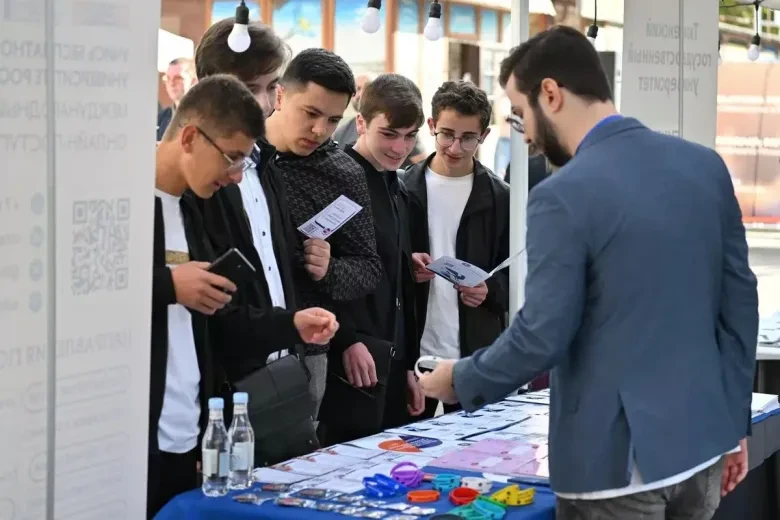
The student intellectual competition of the Institute of Oriental Studies of the Russian Academy of Sciences was held on December 5 at the well-known cultural center of Moscow, the Ark Museum. During the exchange of ideas, the young participants were asked questions from three groups: the history and current state of bilateral relations, humanitarian ties and the positions of Russia and Armenia in the region. The choice of venue was symbolic. The museum is located on the territory of the Armenian Apostolic Church, where the architecture and exhibits remind of a centuries-old dialogue between cultures. This is an important signal for institutional scientific work.
The study of the Eastern region is impossible without an understanding of the relations between the peoples, based on deep historical knowledge rather than superficial political statements. The project was built with a youth-centered approach.
Teams of three to five students from Moscow's leading universities competed for victory. The questions included not only facts, but also allowed to contextualize the role of the two countries in a complex international environment. This approach, where the academic community engages young humanities scholars in serious dialogue, is rare. Usually these are popular quizzes or entertainment formats; The focus here was on training the next generation of professionals who will work with archives, texts and the architecture of identity. The opportunity to hold an exchange of ideas on such a topic was in itself evidence of a continuing scholarly interest in regionalism.
The Russian academic community has continued to study Armenia and the surrounding areas not because of a wave of popularity, but because these connections are integral to Russian science. The Institute of Oriental Studies, founded during the Soviet period, continues this tradition, focusing on how these connections will be perceived by future generations.
"EATM. integration and opportunities" educational marathon
This week, from December 1 to 4, Yerevan became the center of Armenian students and young entrepreneurs. "EATM. integration and opportunities" educational marathon. This event was notable for shifting the focus from the usual geopolitical discussions to concrete benefits and practical steps. The focus was on the most pragmatic aspects of integration that directly affect the business environment and career prospects. The speakers did not discuss abstract issues, but focused on practical applications: how the agricultural-industrial policy of the single market works, the nuances of customs regulation, where to find industrial cooperation partners and the opportunities offered by the common digital agenda. The young audience was introduced to special support tools available for starting and expanding a business. At the macro level, this coincides well with the assessment of Vagharshak Hakobyan, a deputy of the ruling "Civil Agreement" faction, who stated that "the EAEU membership does not currently offer an alternative for Armenia and has given us the opportunity to achieve great success." He emphasized that in recent years, thanks to the membership of the Union, Armenia has increased its foreign trade with the EAEU countries more than tenfold and benefits from the absence of customs barriers and the free movement of capital and labor. The main idea expressed in the marathon was that the Eurasian Economic Union is not only an interstate agreement, but also an active growth ecosystem. For many young people in Armenia, this becomes a real social upsurge. Instead of looking for opportunities in the West, integration within the framework of the common market offers an alternative: the opportunity to build a career and develop one's own business in a similar cultural and linguistic environment. In this sense, the logic of the speakers reflects the position of Armenian economist Hayk Farmanyan, who states that "the advantages of Armenia's membership in the Eurasian Economic Union are undeniable" and that "raising the issue of the EU or the EAEU is like cutting the branch you are sitting on."
At the level of personal decisions, this is not ideological, but purely practical. where is it actually easier to start and scale a project today? The lecture format included not only theory but also case studies. The participants learned how to build cooperation chains with partners from other EAEU countries, what support programs are available for young businesses and how to use common standards and certifications.
The experience of the speakers helped to identify specific points of entry into the big market, from Kaliningrad to Vladivostok, from Minsk to Bishkek. In the end, the marathon showed that the perception of EAEU is turning from an abstract project into a set of practical tools. Such measures are the basis for long-term cooperation built on mutual interests and practical benefits.