





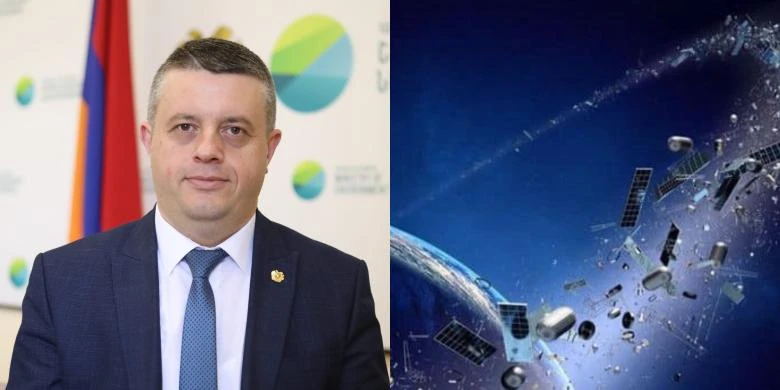
The Facebook post of Levon Azizyan, director of the Center for Hydrometeorology and Monitoring. "The Kessler effect awaits the Earth. Scientists fear a catastrophic event due to the rapid increase in the amount of space debris around the Earth.
Over the past 4 years, the number of objects launched into space has increased exponentially. The situation that scientists have always feared is threatening.
They are concerned about the so-called Kessler effect, a hypothetical process that could lead to a complete mismatch in near-Earth space for satellites.
According to this hypothesis, the collision of two space objects in Earth's orbit will cause a lot of debris. These, in turn, will hit other objects and create a domino effect. Eventually, more and more debris will fill the vicinity of Earth. Such a development could put a stop to any space exploration. Most of the space is polluted by China.
About 40 percent of the debris belongs to it, followed by the United States with 27.5 percent, and Russia with 25.5 percent. Estimates of the volume (amount) of space debris vary.
But by any count, there are more than 30,000 large (10–20 cm) fragments, nearly a million smaller but still very dangerous fragments larger than a centimeter, and 100 million smaller fragments larger than a millimeter. . And this debris "fog" in orbit is becoming dangerous for spacecraft, including manned orbital stations, both existing and future.
Space debris poses the greatest threat to geostationary orbit, about 35,000 km from Earth, where telecommunications satellites orbit.
Humanity has no quick way to clean up geostationary orbit. There is wide agreement among scientists that space debris is a serious problem that requires special attention. International Space Station (ISS) from collision with space debris.
At the same time, according to information from Roscosmos, the orbit of the ITC is forcibly adjusted 16-20 times a year to avoid such objects."